Hello Traders & Investors,
Since 3 August 2026, the closing price of F&O stocks has been discovered through the Closing Auction Session (CAS). If you missed our original explainer on how CAS works, you can read it here.
After reviewing how CAS has worked over the last few months, SEBI has now issued a circular (dated 15 October 2026) that changes CAS timings, extends derivatives trading, and, most importantly for F&O traders, changes how expiry-day settlement prices are calculated.
Here is a quick summary before we go into the details:
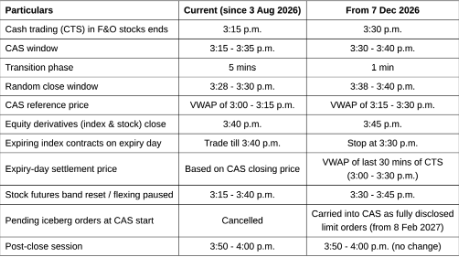
- Cash trading in F&O stocks runs till 3:30 PM again. The 3:15 PM cut-off goes away.
- CAS moves to 3:30 - 3:40 PM and becomes a shorter, 10-minute session.
- Equity derivatives trade till 3:45 PM (up from 3:40 PM).
- Expiry-day settlement no longer uses the CAS closing price. It goes back to a VWAP of the last 30 minutes of trading (3:00 - 3:30 PM).
- Expiring index contracts stop trading at 3:30 PM on expiry day.
- Iceberg orders will be carried into CAS instead of being cancelled (from 8 February 2027).
When does this kick in?

What changes, at a glance
The new end-of-day timeline
From 7 December, here is how the last part of the trading day will look for a CAS-eligible stock:
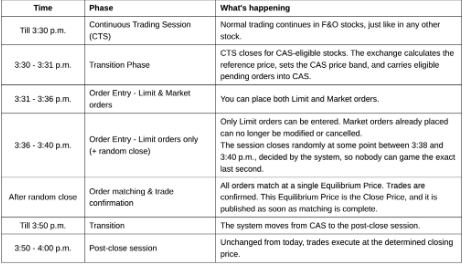
The biggest practical change: you can once again buy or sell F&O stocks in the cash segment (including for delivery) till 3:30 PM. Many of you told us that the 3:15 PM cut-off caught you off guard. From 7 December, that cut-off goes away.
How the equilibrium price itself is discovered (maximum executable volume, minimum imbalance, closest to reference price) stays the same. Our original post covers that in detail.
How is the reference price calculated now?
The reference price is still the anchor for CAS. It sets the price band for the auction and acts as the fallback close if no equilibrium price is found. Only the window and the last fallback change:
-
VWAP of trades in the last 15 minutes of CTS, which is now 3:15 – 3:30 PM.
-
If there were no trades in that window, the stock’s LTP for the day.
-
If there was no trade at all during the day, the previous day’s closing price (adjusted for any corporate action, or the base price).
What changes on expiry day? (Important for F&O traders)
This is the change most F&O traders should pay close attention to.
1. Settlement price goes back to VWAP. Expiry-day settlement prices will no longer be based on the price discovered in CAS. Instead:
-
Index derivatives (Nifty, Bank Nifty, Sensex etc.) will settle at the value of the index calculated using the VWAP of each constituent stock during the last 30 minutes of CTS, i.e. 3:00 – 3:30 PM.
-
Stock derivatives will settle at the VWAP of the underlying stock during 3:00 – 3:30 PM, across all stock exchanges (NSE and BSE combined).
2. You will see the settlement price building up live. During the last 30 minutes (3:00 – 3:30 PM), the exchanges will calculate and publish, in real time:
-
an indicative value of the underlying index for index derivatives, and
-
an indicative VWAP of the underlying stock for stock derivatives.
So instead of waiting for an auction result to know where your contracts will settle, you will be able to track the likely settlement price as it forms.
3. Expiring index derivatives contracts stop trading at 3:30 PM
On expiry day, trading in expiring index derivatives contracts will stop at 3:30 PM, which is exactly when the settlement window ends. Non-expiring index contracts continue till 3:45 PM as usual.
Stock derivatives, however, continue trading till 3:45 PM on all days, including expiry day. Keep in mind that on expiry day, the settlement price of expiring stock contracts is already fixed by the 3:00 – 3:30 PM VWAP, even though trading continues after that.
What happens to your pending orders? (From 8 February 2027)
This part comes into effect two months later, on 8 February 2027.When CTS ends at 3:30 PM, pending orders will be handled - Pending limit orders are carried into CAS, except:
-
Stop Loss orders, and
-
orders priced outside the CAS price band.
Pending iceberg orders that are within the CAS price band will no longer be cancelled. They will be carried into CAS as fully disclosed limit orders, i.e. the full quantity becomes visible. If you don’t want this, you can opt out at the time of placing the original iceberg order.
Time priority inside CAS will work in this order:
-
Regular limit orders carried over from CTS
-
Iceberg orders carried over from CTS (among these, priority is based on when the original iceberg order was placed)
-
Limit orders placed fresh during CAS
You can modify an order that was carried over into CAS, but it will lose its time priority once modified.
What about special trading sessions?
On special trading days (like Muhurat Trading), the closing price of CAS-eligible stocks will also be discovered through CAS, with the same 10-minute duration. The derivatives segment will close 5 minutes after CAS ends, and a 10-minute post-close session will begin 5 minutes after that.
We will share more details (and update our product flows) as the exchanges release their detailed guidelines. We will keep you posted on the intraday square off timings change on Dhan
Happy Trading!