One of the oldest investing beliefs is:
“Never buy a stock making a new 52-week high.”
At the same time, another common belief is:
“Buy stocks near their 52-week low because they’re cheap.”
Both statements sound logical.
But are they actually true?
Let’s understand the psychology behind both.
What Is A 52-Week High?
A 52-week high is simply the highest price a stock has traded at over the last one year.
Similarly, a 52-week low is the lowest price it has traded during the same period.
These levels are watched by almost every type of market participant:
• Retail investors
• Swing traders
• Mutual Funds
• Institutions
• Quantitative Funds
Not because the numbers themselves are magical…
But because they often represent important shifts in market psychology.
Why Do Stocks Making New Highs Attract Attention?
When a stock breaks above its previous 52-week high, something interesting happens.
There Are Very Few “Trapped” Investors
Imagine buying a stock at ₹900.
It falls to ₹700.
Months later it returns to ₹900.
Many investors finally get a chance to exit at breakeven.
This selling creates resistance.
Now imagine a stock making a new 52-week high.
Almost everyone who bought earlier is sitting on profits.
There are fewer investors waiting to “just recover their money.”
This often reduces overhead supply and allows price to move more freely if buying continues.
New Highs Often Reflect Strength
A stock reaching new highs may indicate:
• Strong earnings growth
• Positive business outlook
• Institutional accumulation
• Sector leadership
• Improving investor confidence
Of course, a new high doesn’t guarantee further gains.
But markets often reward businesses that continue to exceed expectations.
Then Why Are Investors Afraid To Buy?
Because of psychology.
A stock moving from ₹600 to ₹1,000 feels “expensive.”
Many investors think:
“I’ve already missed the rally.”
Ironically, some of the biggest wealth creators have spent years making new highs while continuing to grow.
Price alone doesn’t tell you whether a stock is expensive.
Business performance and future expectations matter just as much.
What About 52-Week Lows?
Now let’s look at the other side.
Many investors get excited when they see:
“This stock is down 60%.”
“It must be a bargain.”
But a falling stock isn’t necessarily undervalued.
Sometimes it’s simply reflecting new information.
Why Do Stocks Make New Lows?
There can be many reasons:
• Weak earnings
• Slowing business growth
• Debt concerns
• Regulatory changes
• Sector-wide weakness
• Global macro events
• Reduced investor confidence
Sometimes the market is overreacting.
Sometimes it’s correctly pricing deteriorating fundamentals.
The challenge is knowing the difference.
The Psychology Behind 52-Week Lows
A fascinating behavioural bias comes into play.
Many investors anchor to previous prices.
For example:
“This stock was ₹2,000 last year.”
“Now it’s ₹1,000.”
“It has to go back.”
But markets don’t care where the stock traded in the past.
They care about what the business is worth today and what investors expect it to be worth in the future.
A stock can fall 50%…
…and still be overvalued.
Similarly, another stock can make a new high…
…and still be fundamentally attractive.
Should You Buy High Or Buy Low?
Neither approach works on its own.
Instead, ask questions like:
For a 52-week High:
• Why is the stock making new highs?
• Are earnings supporting the move?
• Is volume confirming the breakout?
• Is the sector also strong?
For a 52-week Low:
• Why is the stock falling?
• Has the business fundamentally changed?
• Is the decline sentiment-driven or business-driven?
• Could this be value, or a value trap?
The “why” is often more important than the price itself.
Curious To Explore 52-Week High & Low Stocks?
If you’d like to track them yourself:
Open the Dhan App →Go to Watchlist →Open the Movers section :
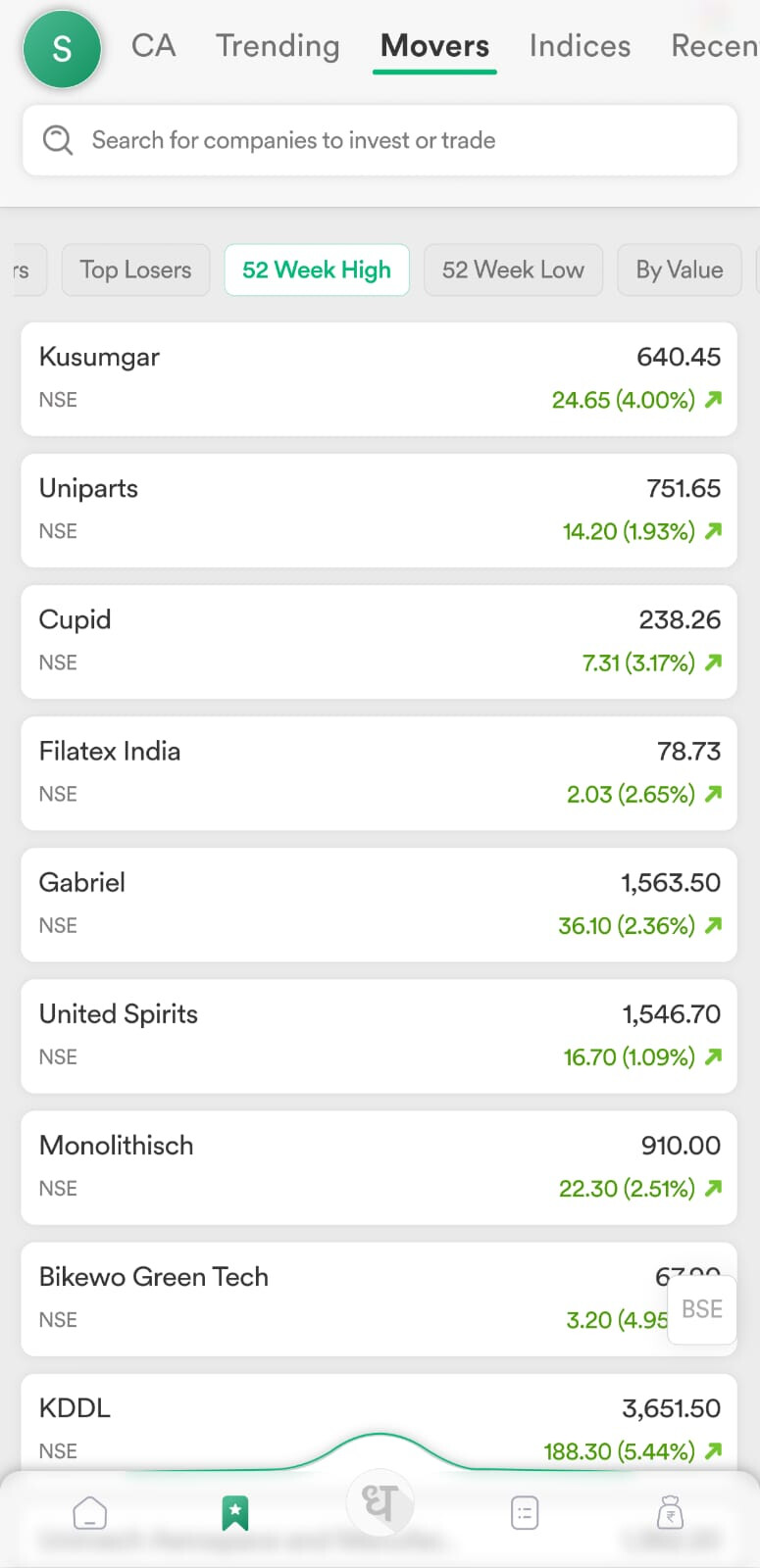
There you’ll find stocks making 52-Week Highs and 52-Week Lows, making it easy to identify where the market is showing the strongest momentum or the weakest sentiment.
It’s a great starting point for further research rather than a buy or sell signal.
Let’s Discuss
• Do you feel more comfortable buying stocks making new highs or new lows?
• Have you ever found a great investment from the 52-week high or low list?
• Do you think momentum or value works better in the long run?
• Which recent stock surprised you by continuing to rally after making a new 52-week high?
It would be interesting to know how different investors approach these two very different opportunities.
Disclaimer: This post is intended for educational and discussion purposes only. A stock trading near its 52-week high or low does not indicate that it is overvalued or undervalued. Investment decisions should always be based on thorough research and individual risk tolerance.