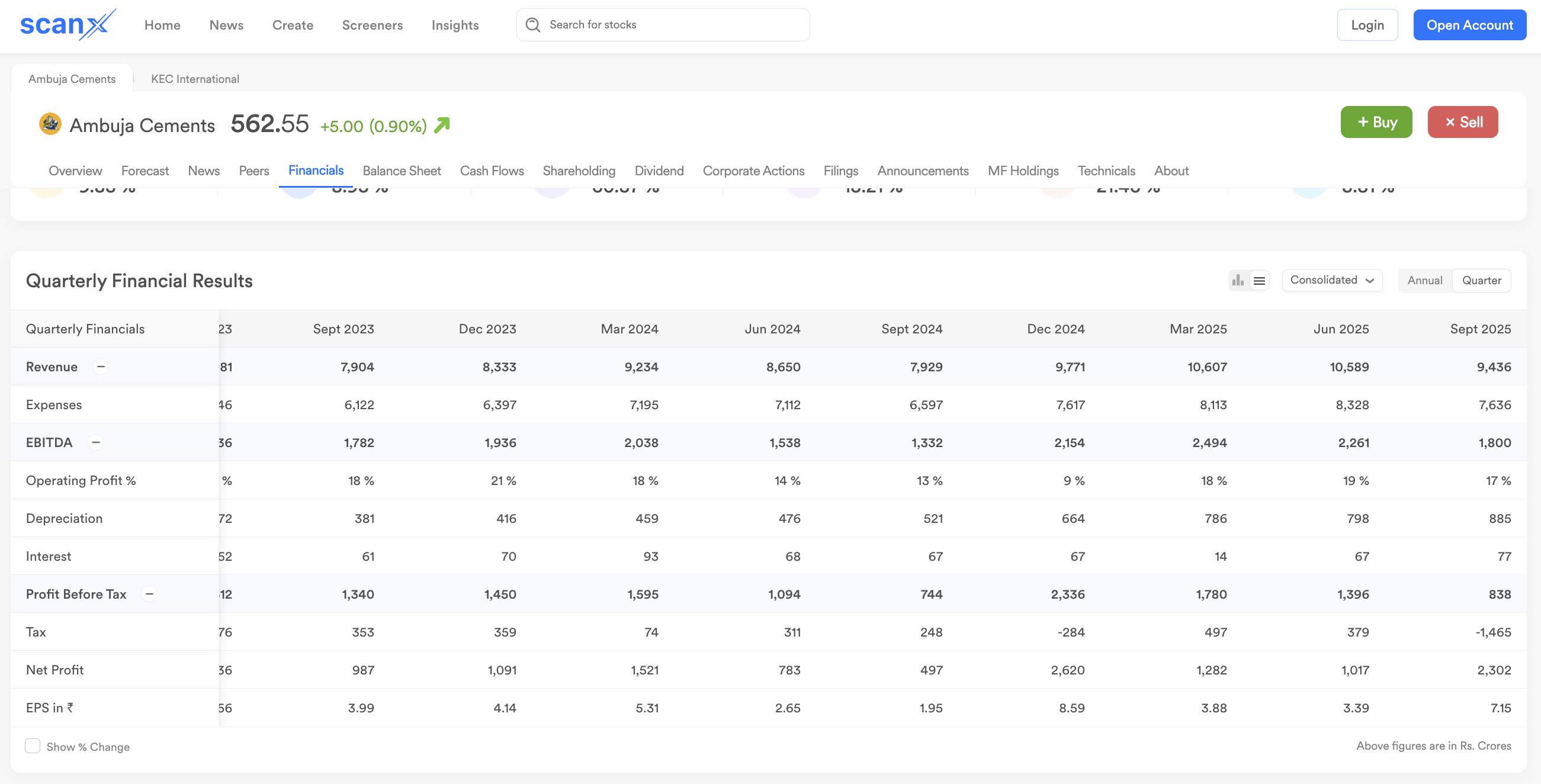
Ambuja Cements reported a net profit of ₹2,302 crore.
But here’s the twist —
only ~30% of that profit came from selling cement.
Recently, Ambuja Cements announced their quarterly results, and the headline was everywhere:
“Profit Surges 364% to ₹2,302 Crore!”
A number so big your uncle probably called asking if he should buy the stock.
But when you dig deeper, something interesting shows up.
 What actually happened?
-
Ambuja’s profit before tax (PBT) was only ₹838 crore.
-
With a normal 20–25% tax rate, the PAT should have been roughly ₹600–650 crore.
-
Instead, they reported ₹2,302 crore PAT.
Why?
Because they added a one-time gain of ₹1,697 crore due to an Income Tax Reversal — basically, old tax disputes being settled in Ambuja’s favor.
Think of it like this:
If you once paid ₹100 as tax assuming you owed it, but after years of dispute the department returns it — that refund becomes part of your profit for that period.
Ambuja just got that refund.
That’s the extra ₹1,697 crore.
So yes, the headline profit surged,
but 70% of that jump wasn’t from selling cement.
The good news: Ambuja’s business IS improving.
Here are the real operating numbers:
-
Revenue up 25% YoY → ₹9,129 crore
-
EBITDA up 58% YoY → ₹1,761 crore
-
Volumes up 20% → 16.6 MT
The core business is getting stronger —
but that’s not what drove the 364% profit jump.
So when you analyze any company’s results, use this 3-layer approach:
-
Headline Profit (what newspapers highlight)
-
Adjusted Profit (remove one-time gains/losses)
-
Operating Metrics (revenue, volume, margins — real business health)
What are you views on this? Is this sustainable for growth - how do you think about it?