FPIs sold ₹2.3 lakh crore in April. The more interesting question is why the market stopped caring

Hi everyone,

Yesterday an article came in the business standard making a point a lot of us have felt in our portfolios: through the West Asia tension, foreign investors have been heavy sellers while domestic institutions and retail have quietly held the market up. The article puts it plainly, FPIs net sellers, DIIs channelling money in, and retail snapping up ₹19,664 crore in April, their biggest single month since October 2024.
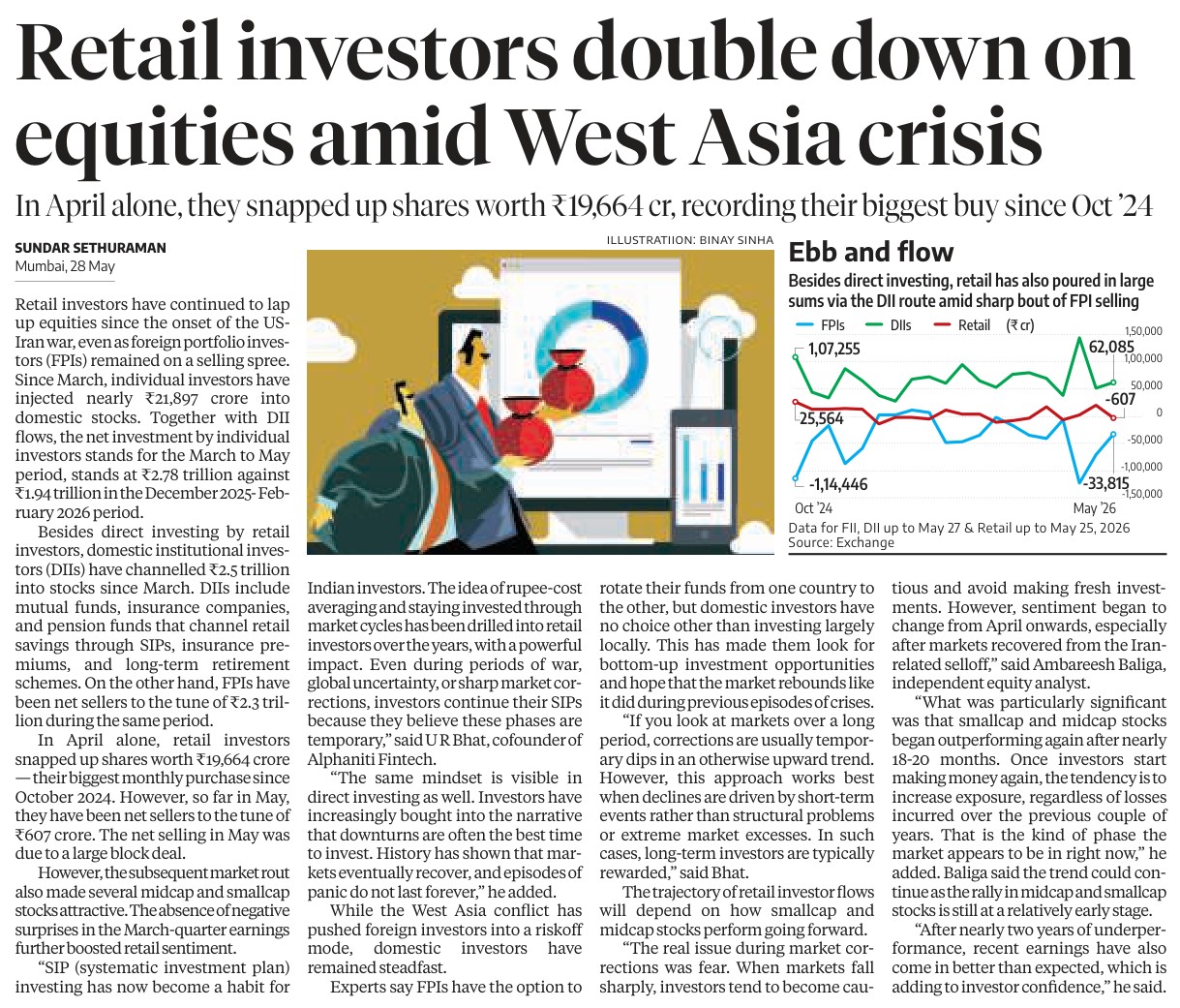
It’s a good read, and the flow data backs every word of it. What the data adds is the precision the headline can’t, just how cleanly domestic money matched the foreign exit.

The offset was almost rupee for rupee

Lay the March and April flows side by side:

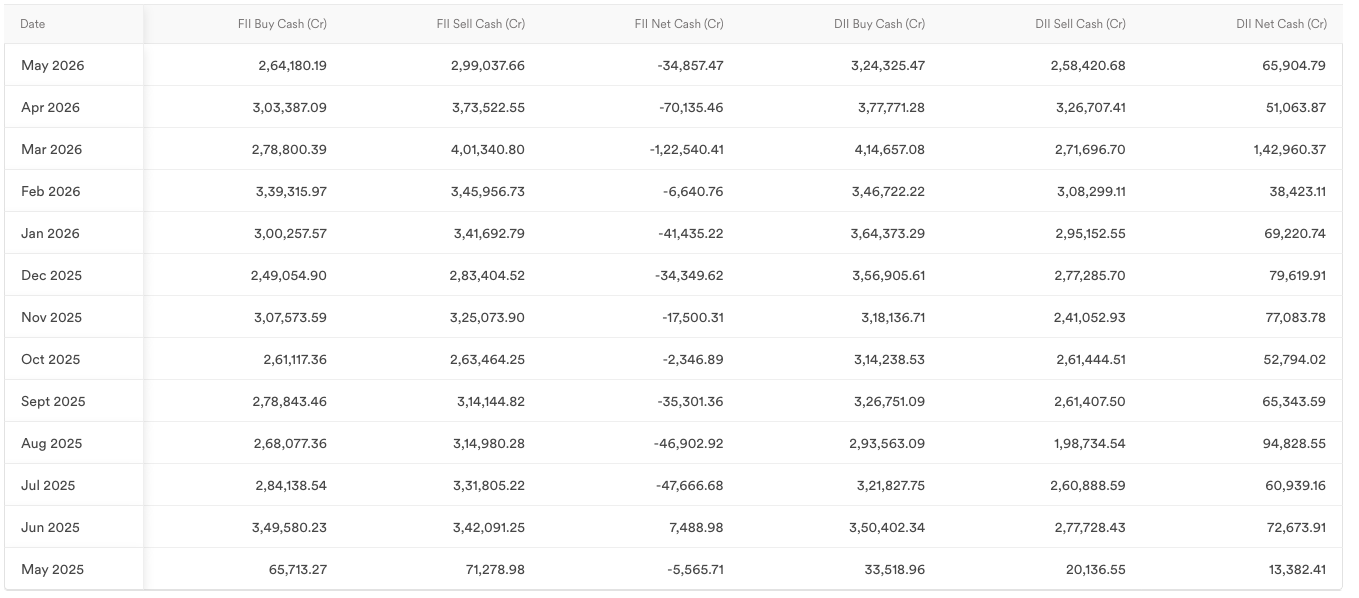
Month FII net (₹ cr) DII net (₹ cr)
Mar 2026 -1,22,540 +1,42,960
Apr 2026 -70,135 +51,064
Two-month total -1,92,675 +1,94,024

Here’s the data from ScanX insights as well:

Foreigners took out roughly ₹1.93 lakh crore. Domestic institutions put in roughly ₹1.94 lakh crore. The gap between the two is about ₹1,350 crore, which on a base this size is essentially a rounding error. When the article says DIIs steadied the market, this is what that sentence looks like in numbers: not a vague cushion, but an almost exact, month-on-month absorption of everything the foreigners sold.

Retail wasn’t just present. It leaned in.

The ₹19,664 crore of direct retail buying in April being the biggest since October 2024 isn’t a small footnote. It tells you the dip-buying reflex the article describes, the SIP-bred habit of treating falls as opportunities, has graduated from autopilot into active conviction. People didn’t just keep their SIPs running through the scare. They added on top, deliberately, while the headlines were at their worst.

Why the precision matters

A near-perfect FII-DII offset is a structurally calmer market than the raw “₹2 lakh crore sold” headline suggests. It means foreign exits were being met by a domestic bid deep enough to clear them without forcing a disorderly fall. That’s exactly why the broader market could begin its smallcap and midcap recovery even while FPIs were still leaving, the selling had a buyer waiting on the other side every single month. The article gets the direction right. The flow data shows the mechanism. (Worth reading next to the rupee thread, since a softer currency is half the reason the FPIs were heading out in the first place.)

And the freshest reading? The pressure is easing.

Bringing it right up to now: the most recent prints suggest the foreign selling is losing steam. May’s monthly FPI outflow has shrunk to roughly ₹35,000 crore, well below March and April, while DIIs kept buying. The latest daily and weekly numbers tell the same story, FIIs still nibbling on the sell side (around -₹1,043 cr on the day, -₹2,629 cr on the week) against steady DII buying (+₹3,821 cr daily, +₹9,039 cr weekly). The tug of war the article describes is still on. It’s just gotten a good deal quieter.

When the selling was at its scariest in March, were you a buyer or a watcher?

5 Likes

Well the most interesting point is when FII’s wanted to sell, they got an easy exit because of DIIs channeling in money. No issues at all. Just sell, get the money, take it out and pool it into another market. Also look at the US bond yield. Its at the top and with India having so many taxes, I don’t think the FII sell off is going to stop. For a real stop to happen, India needs to look at how it changes LTCG, STCG and also STT. If this really happens, the returns from India that an FII gets will be higher compared to other markets and hence it would become attractive.

Quite an interesting bit, Us bonds yields are at all time high. For larger community, can you please write about it on the community? I am sure a lot of users might be benefitted from it

Sure will try to write on it but the main concept is where exactly the FIIs are getting the most benefit risk free. Is the FII getting less than 4.5% post all the tax and charges(LTCG, STCG, STT, DP charges, GST etc) on their investment or more. To add to it, the share market has risk. For a good rally and for a good period, LTCG and STT needs to be looked. In my perspective, remove STT for sure and lower LTCG to say 6% from the current 12.5% and in future remove it completely would be the right move going forward

1 Like

I have a feeling they will make it 0 if held for 3+ years. STT, they should remove it for the cash segment for sure… I want it out for Fno too, but that would be wishful thinking…

1 Like

Brilliant data breakdown, Rahul sir ! but Looking at it from a macro and ground reality perspective, the logic here is very deep. Right now, with major geopolitical tensions like the Iran-Israel-US conflict, markets are highly volatile. When FIIs go completely silent with their selling and DIIs actively absorb the pressure, it shows where the real strength lies.

As traders, we can never be 100% sure about a single direction or call it a pure trap, but the structural shifting of liquidity is obvious. The most interesting part is that despite the hype, India doesn’t even have the core AI infrastructure or chip manufacturing factories yet, unlike saturation-point markets like China.

But this exact gap makes India a ‘Jackpot Opportunity’ and a massive booster for smart money. Developed markets face violent panic cuts, but India is just starting its beautiful, resilient growth journey. This FII-DII offset clearly proves that instead of a crash, institutional players are treating this global panic as a structural buying zone. Great write-up

1 Like

Well for the “Jackpot Opportunity“, India should be a place where investments are attractive. Its a cycle where to woo in an investment, you need to make the space attractive and then one thing leads to the other which ultimately ends in a rally and benefits. India is making efforts in the data center area but it needs more investments in the space and this is what is going to be the foundation for the others but it needs a massive investment and fresh money coming in.

1 Like

Exactly @nitishbangera . Data centers will act as the perfect foundation. To attract big players long-term, the government needs to bring stable FDI policies and tax incentives. Also, when trusted groups like Tata or Reliance launch new specialized companies in these tech sectors, it will give foreign institutional investors the necessary confidence to pour in fresh money. Once that happens, India growth story will get a strong boost.

I agree. Along with data centers and infrastructure, policy stability will be a key factor. Global investors usually look for long-term visibility before committing large capital. If India can continue improving ease of doing business, support advanced manufacturing, and create a strong technology ecosystem, it could attract significant foreign investment over the next decade. The opportunity is definitely there; execution will be the deciding factor.

1 Like