Can a stock market lose billions in value simply because global investors stop trusting how it operates?
That’s the question facing Indonesia’s stock market.
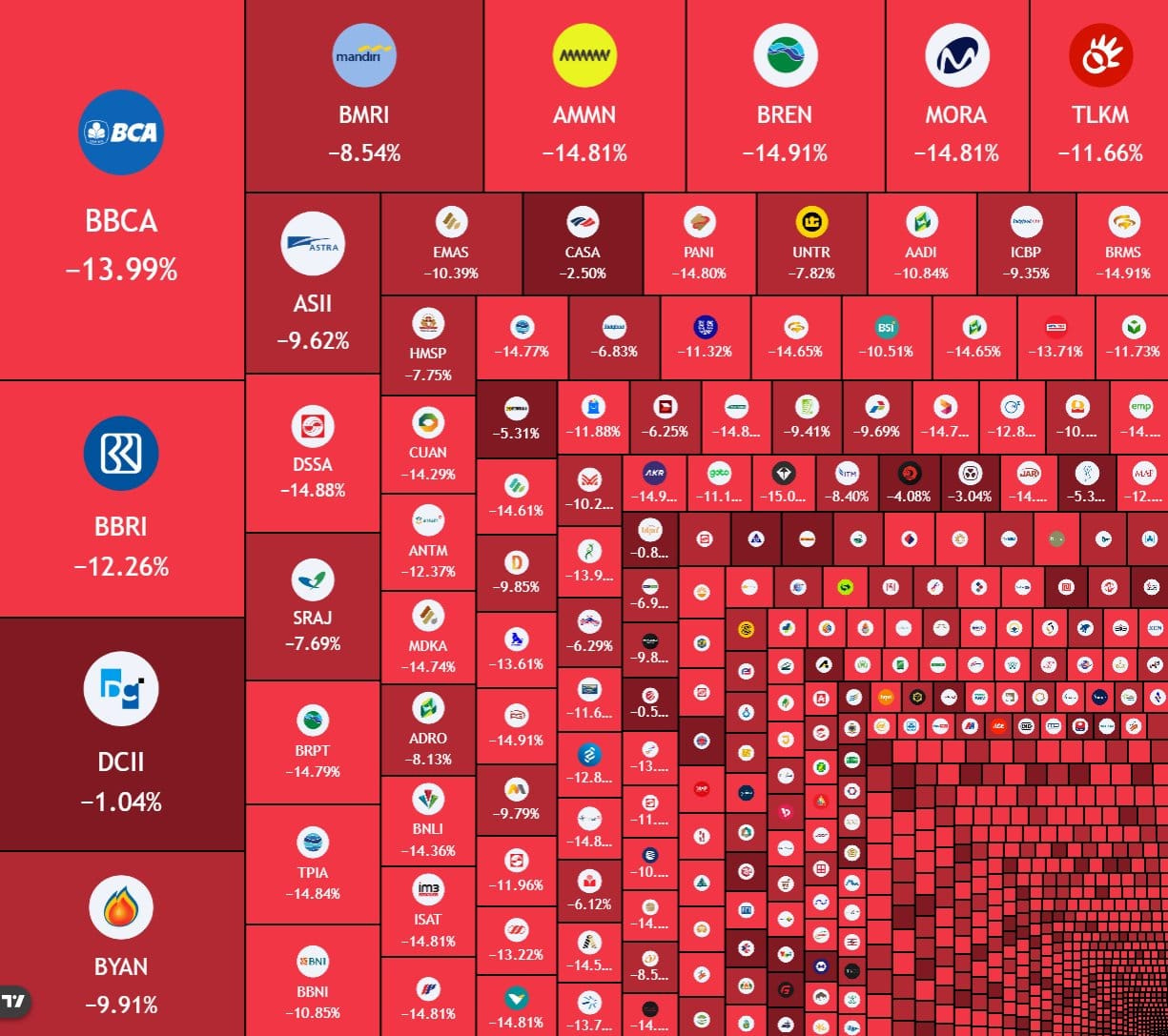
Today, the Jakarta Composite Index (JCI) reportedly plunged 11.57%, marking one of its sharpest single-day declines since the Asian Financial Crisis of 1998.
At the same time, the Indonesian Rupiah weakened beyond the psychologically important 18,000 per US dollar level.
But the bigger story isn’t just falling stock prices.
It’s about market transparency, corporate governance, foreign investor confidence, and the possibility of Indonesia losing its Emerging Market classification.
1. What Triggered the Sell-Off?
At the centre of the concern is MSCI, one of the world’s most influential index providers.
Global mutual funds, ETFs, pension funds, and institutional investors use MSCI indices to decide how capital should be allocated across countries.
According to the reported developments, MSCI has raised serious concerns about Indonesia’s market accessibility and investability, with a potential downgrade to Standalone Market status under discussion.
Why does this matter?
Because Indonesia currently benefits from being part of the global Emerging Markets investment universe.
If its classification changes, funds tracking Emerging Markets indices may need to reduce or eliminate their Indonesian equity exposure.
A market classification decision can therefore influence billions of dollars in investment flows.
2. The Bigger Problem: Transparency and Market Manipulation
MSCI’s reported concerns go beyond market performance.
They involve fundamental questions about how Indonesia’s stock market operates.
Unclear free-float ownership
Free float represents shares genuinely available for public trading.
When ownership is concentrated or difficult to verify, investors may struggle to understand how liquid a stock actually is.
The problem of Saham Goreng
Indonesia has a term called Saham Goreng, often translated as “fried stocks.”
It refers to stocks whose prices may be artificially inflated through coordinated or manipulative trading activity.
Such practices can create misleading price movements and expose investors to sudden losses.
Corporate governance and enforcement
Foreign institutions also evaluate how effectively exchanges and regulators enforce disclosure requirements, ownership transparency, and market integrity.
When confidence in these systems weakens, investors may demand a higher risk premium or reduce exposure altogether.
3. Why Could an MSCI Downgrade Trigger More Selling?
Imagine a global Emerging Markets ETF managing $10 billion.
If Indonesia represents 1.5% of its benchmark, the fund might hold approximately $150 million in Indonesian equities.
Now imagine Indonesia is removed from that benchmark.
The ETF would generally need to adjust its holdings to reflect the revised index.
Multiply this across numerous passive funds and benchmark-sensitive institutional portfolios.
The potential selling pressure becomes significant.
Estimates cited in the reported developments suggest that $13–19 billion in portfolio capital could be affected by a downgrade.
However, these are estimates of potential investment outflows, not confirmed losses or money that has already exited the economy.
4. Why Is the Indonesian Rupiah Also Falling?
The pressure isn’t limited to equities.
The Rupiah reportedly weakened beyond IDR 18,000 per USD, reflecting concerns about foreign capital flows and broader economic conditions.
Here’s how equity-market stress can affect a currency:
-
Foreign investors sell Indonesian shares.
-
Some investors convert the proceeds from Rupiah into US dollars.
-
Demand for dollars increases relative to the local currency.
-
The Rupiah faces additional depreciation pressure.
A weaker currency can make imports more expensive and complicate inflation management.
However, currency movements also depend on global dollar strength, interest-rate expectations, trade flows, and central-bank intervention.
5. What Happens If Indonesia Loses Emerging Market Status?
The consequences could extend beyond a one-time market correction.
Potential effects include:
-
Reduced participation from global institutional investors.
-
Forced portfolio rebalancing by index-tracking funds.
-
Lower liquidity in certain Indonesian equities.
-
Higher financing costs for listed companies.
-
Greater pressure on the Rupiah.
-
A higher risk premium demanded by foreign investors.
Importantly, a downgrade would not mean Indonesia’s economy stops functioning or that all foreign investors must exit.
But it could make attracting international portfolio capital more difficult.
6. What Can Other Emerging Markets (Like India) Learn From This?
Indonesia’s situation raises a much larger question for emerging economies, including India.
Is economic growth enough to attract global capital, or is market transparency equally important?
Foreign investors don’t evaluate countries only on GDP growth, earnings, or valuations.
They also consider:
-
Corporate governance
-
Ownership disclosures
-
Market liquidity
-
Regulatory enforcement
-
Settlement infrastructure
-
Investor protection
A rapidly growing economy can still struggle to attract institutional capital if investors lose confidence in its financial markets.
That’s what makes this development worth watching beyond Indonesia.
The Bigger Question: Can Market Confidence Be Rebuilt?
Stock markets can recover from corrections.
Currencies can stabilize.
Capital flows can reverse.
But rebuilding institutional trust can take considerably longer.
Indonesia’s next steps on ownership transparency, regulatory enforcement, and market accessibility could prove important in determining how international investors view its market.
Let’s Discuss
-
Can an MSCI classification decision have a greater impact on a market than corporate earnings or economic growth?
-
Would you consider investing in a market facing governance concerns simply because valuations have fallen significantly?
-
What lessons should Indian investors and regulators take from Indonesia’s experience?
Disclaimer: This post is for educational and discussion purposes only. It discusses reported market developments and potential scenarios, not investment recommendations. A proposed index reclassification is not equivalent to a final decision, and estimated capital outflows are not guaranteed.