Moderna and Merck announced positive Phase 3 results for intismeran autogene, an experimental personalised mRNA-based cancer therapy, used alongside Merck’s Keytruda for patients with high-risk melanoma after surgery.
The study met both:
• Recurrence-free survival: delaying/preventing the cancer from returning
• Distant metastasis-free survival: delaying/preventing the cancer from spreading elsewhere
It is being described as the first positive Phase 3 result for an individualised neoantigen therapy and for an mRNA-based cancer therapy.
And this is where the story becomes particularly interesting.
Where does AI come into this?
This isn’t a conventional “one medicine for everyone” approach.
Every patient’s tumour can have a different set of genetic mutations.
So the process broadly looks like this:
Tumour sample → Genetic sequencing → AI/algorithms → Personalised mRNA → Immune response
Think of the tumour as having a unique genetic fingerprint.
Moderna says its AI algorithms analyse sequencing data from the patient’s tumour and blood, study the mutations and predict up to 34 neoantigens that are most likely to generate an immune response.
An individualised mRNA medicine can then be designed around those targets.
In simple terms:
AI helps decide what to target.
mRNA carries the instructions.
The immune system does the fighting.
AI is therefore not “curing cancer” here. It is acting as an intelligence layer that helps turn enormous amounts of genomic information into something potentially actionable for an individual patient.
And Moderna is also using AI on the manufacturing side — scheduling thousands of patient-specific batches and coordinating production, quality checks and delivery. When one patient can effectively require one customised medicine, that operational layer becomes incredibly important.
Why did the market react so aggressively?
Because investors weren’t necessarily looking at this as the success of just one drug.
They were potentially looking at it as validation of a platform.
For years, the big question around Moderna was:
Can mRNA become much more than a COVID vaccine technology?
A successful late-stage cancer study makes that question significantly more interesting.
The same personalised mRNA approach is already being studied across other tumour types, including lung, kidney and bladder cancers.
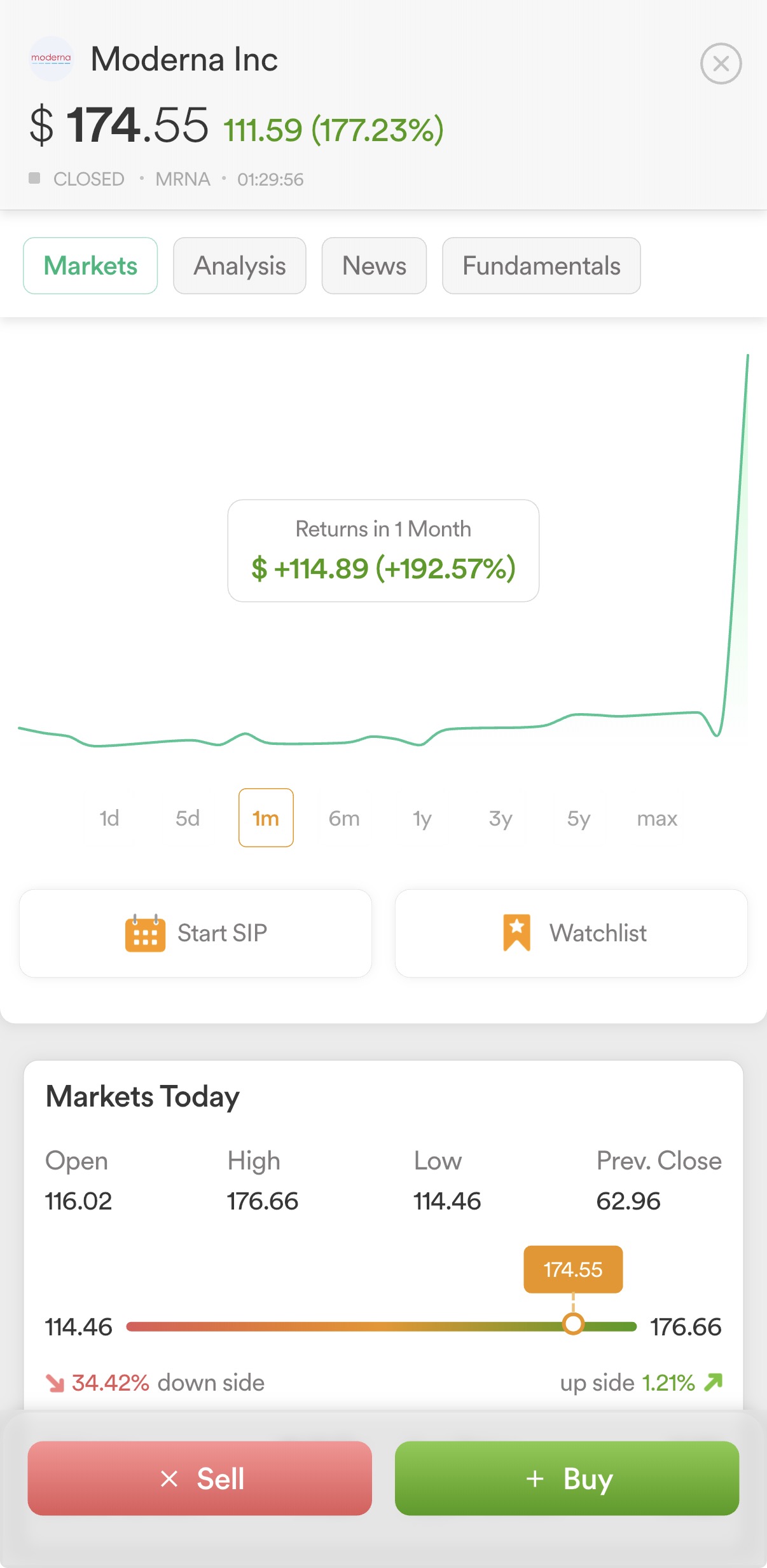
There was another market element too: Moderna had significant short interest going into the announcement, so a short squeeze likely amplified an already extraordinary move in the stock.
One important distinction
This isn’t an announcement that “cancer has been cured.”
The therapy is still investigational. Detailed Phase 3 data, overall-survival outcomes, regulatory review and the ability to manufacture personalised treatments commercially at scale will all matter from here.
But scientifically, this is still a fascinating milestone.
A technology most of the world first came across through COVID vaccines is now being combined with genomics, AI, personalised manufacturing and immunotherapy to potentially teach someone’s immune system to recognise the specific fingerprint of their cancer.
Sometimes a 177% stock move is speculation.
Sometimes the market is trying to reprice what a company could become.
Moderna’s move this week is an interesting example of why understanding the technology behind the ticker can be just as important as watching the ticker itself.
For educational purposes only. Not an investment recommendation.