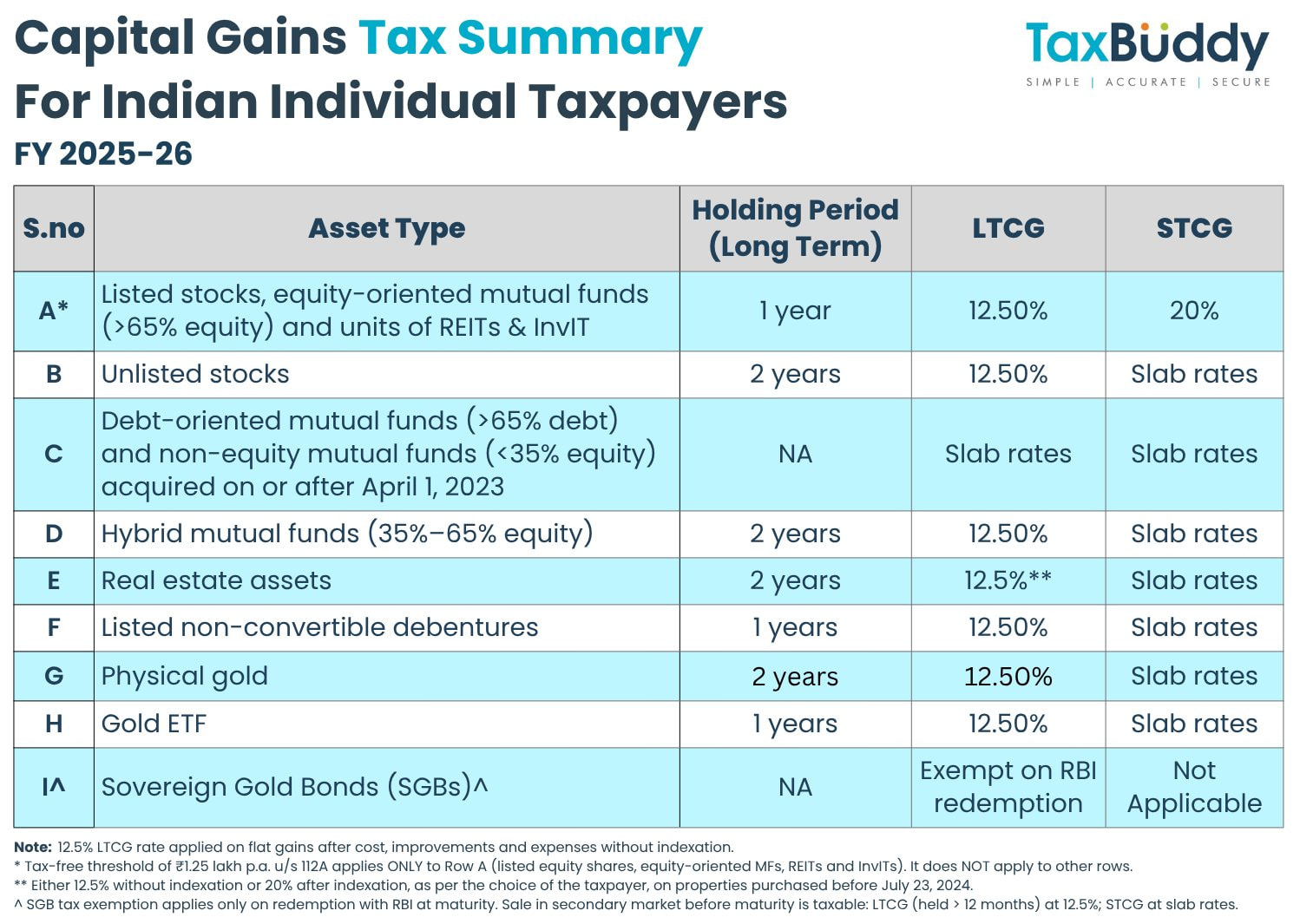
Indians paid over ₹98,681 crore as LTCG tax on listed equities and mutual funds in FY23 alone. A big chunk of that could have been reduced with better planning. The rules vary sharply across assets, and mixing them up leads to costly mistakes.
This is a quick reference to get the rates and holding periods right, asset by asset.
Listed Equity Shares and Equity Mutual Funds
- Hold more than 12 months: LTCG at 12.5% on gains above ₹1.25 lakh
- Hold 12 months or less: STCG at 20%
These rates apply to sales made on or after 23 July 2024
Debt Mutual Funds (over 65% debt)
- Bought before 1 April 2023: hold over 24 months = 12.5%; hold less = slab rates
- Bought on or after 1 April 2023: always taxed at slab rates, regardless of how long you hold
No indexation benefit in either case
Hybrid MFs (under 35% equity) and Market-Linked Debentures
- Bought before 1 April 2023: over 24 months = 12.5%; under 24 months = slab rates
- Bought on or after 1 April 2023: always slab rates under Section 50AA
These are always treated as short-term. No LTCG benefit available
Hybrid Mutual Funds (35% to 65% equity)
- Hold over 24 months: 12.5%, no indexation
- Hold 24 months or less: slab rates
Date of purchase does not change the rule here, unlike debt funds
Sovereign Gold Bonds (SGB)
- Redemption directly through RBI by an individual: fully exempt under Section 47(viic)
- Sold on secondary market after 12 months: 12.5%, no indexation
- Sold on secondary market within 12 months: slab rates
Non-Convertible Debentures (NCDs)
- Listed NCDs held over 12 months: 12.5%, no indexation
- Listed NCDs held 12 months or less: slab rates
- Unlisted NCDs: always slab rates, regardless of holding period
Real Estate (Residential, Commercial, Land)
- Hold over 24 months: LTCG at 12.5%, no indexation
- Hold 24 months or less: STCG at slab rates
- Bought before 23 July 2024: option available to pay 20% with indexation instead
Physical Gold and Gold ETFs
- Physical gold held over 24 months: 12.5%, no indexation
- Gold ETFs held over 12 months: 12.5%, no indexation
- Below the respective holding periods: STCG at slab rates
Cryptocurrencies and NFTs (Virtual Digital Assets)
- Flat 30% under Section 115BBH, regardless of holding period
- Applies whether the VDA is a capital asset or not
No loss set-off, no indexation, no carry-forward of losses
Key Takeaway
The holding period threshold, the date of purchase, and the asset type all affect the final tax rate. These are not uniform across categories.
For most people, the biggest savings come from understanding two things: when LTCG exemption thresholds apply (listed equity), and when buying date locks in a different tax treatment entirely (debt funds post-April 2023).
All figures are based on the FY 2025-26 (AY 2026-27) framework.