One market in the global ETF return table clearly stands out: South Korea.
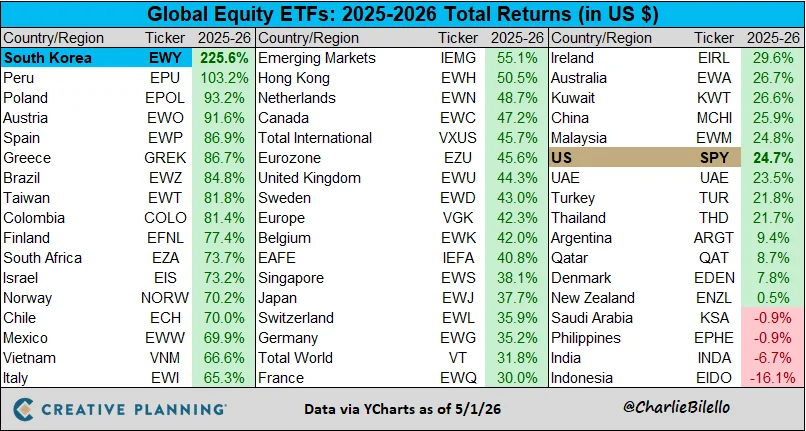
While the US has delivered strong returns and several emerging markets have bounced well, South Korea’s move is in a different league. EWY, the South Korea ETF, is showing around 225% returns in USD terms for the 2025 to 2026 period.
This was not a random rally. Korea had a rare combination of four powerful triggers: AI hardware exposure, a turning memory cycle, governance reform, and renewed global flows.
The biggest reason is Korea’s position in the AI supply chain. While most investors focus on Nvidia, Microsoft, Alphabet, Meta, and Amazon, the AI boom also depends on physical infrastructure: data centres, GPUs, advanced memory, and semiconductor supply chains. South Korea sits right in this layer through companies like SK Hynix and Samsung Electronics.
SK Hynix has become one of the biggest beneficiaries of high-bandwidth memory demand, which is critical for AI servers and Nvidia GPUs. Reuters noted that Korea’s technology sector has been a major driver of the market, with SK Hynix gaining sharply on AI optimism and HBM demand.
The second reason is the memory cycle. Memory chips are highly cyclical. When demand is weak, pricing and margins collapse. But when supply tightens and demand accelerates, earnings can change very quickly. That is what investors are now pricing in. SK Hynix recently announced a major investment of around 19 trillion won in a new South Korea plant for advanced packaging to meet rising AI memory demand. This tells us the market is looking at a multi-year demand cycle, not just one strong quarter.
The third reason is Korea’s corporate reform push. For years, Korean equities traded at a valuation discount because of governance concerns, chaebol structures, weak minority shareholder treatment, and low payouts. The government’s Corporate Value-Up Program is trying to improve capital efficiency and shareholder returns. That matters because Korea is not only getting earnings upgrades, it is also getting a valuation re-rating.
That is why the Korea trade worked so well.
It gave investors AI exposure, earnings upgrades, cheap valuations, reform momentum, and strong flows in one market.
This also explains why Indian AMCs and platforms are looking more seriously at Korea-linked ETF exposure. The trend is bigger than Korea alone. Indian investors are moving from generic global diversification to theme-led and country-specific diversification. Earlier, international investing mostly meant the US or Nasdaq. Now investors want access to specific global supply chains like AI chips, semiconductors, robotics, defence, energy transition, and advanced manufacturing.
Korea fits this shift because it offers something Indian portfolios do not have enough of: direct listed exposure to the AI hardware and memory cycle.
The US also performed well, but for a slightly different reason. SPY is showing around 24.7% returns in the table. The US rally was driven by AI leadership, resilient earnings, mega-cap technology strength, and confidence that large American companies can convert AI spending into real revenue growth.
The US is not just a semiconductor trade. It is a broader AI ecosystem trade. Nvidia, Microsoft, Alphabet, Amazon, Meta, Apple, cloud platforms, software, advertising, and enterprise AI adoption all played a role. Reuters described 2025 as a strong year for Wall Street, with AI-focused stocks dominating the market narrative. That is why the US remains the deepest and most liquid market for global investors playing the AI theme.
Other markets also did well because global investors rotated into cheaper and under-owned markets. Peru, Poland, Austria, Spain, Greece, Brazil, Colombia, South Africa, and Chile benefited from a mix of valuation catch-up, stronger currencies, commodity exposure, domestic reforms, and rate-cut expectations. Taiwan did well for the same broad reason as Korea: semiconductor exposure. Japan and parts of Europe benefited from governance reform, shareholder returns, and cheaper valuations.
Now comes the India question.
India being near the bottom does not mean the India story is broken. But it does show that markets care about starting valuations and near-term earnings triggers.
India entered this period with expensive valuations compared to many emerging markets. That premium was supported by strong domestic flows, political stability, structural growth, and long-term confidence. But global investors found cheaper markets with faster earnings upgrades and more direct exposure to the AI hardware cycle.
India also does not yet have a listed-market equivalent of SK Hynix or TSMC that global investors can buy as a direct AI infrastructure proxy. We have strong themes in financials, manufacturing, defence, power, consumption, capital markets, and digital platforms, but the global AI trade rewarded semiconductor-heavy markets more directly.
Foreign outflows, rupee pressure, expensive valuations, and earnings moderation also weighed on Indian equities. So India’s underperformance should be read as a relative opportunity cost, not a collapse of the long-term story.
The real learning from Korea is this:
Markets reward a combination of earnings upgrades, liquidity, flows, valuation comfort, and a strong narrative.
Korea had all five.
India has the long-term narrative, but the market is waiting for the next earnings and flow trigger.
For Indian traders and investors, the key question is not whether to chase Korea after a 225% move. The better question is:
Which market or sector has similar ingredients before the move becomes obvious?
Is Korea still a momentum trade, or has the easy money already been made?
And is India’s underperformance a warning sign, or the beginning of the next relative opportunity?
This is for educational discussion only and not a recommendation. Please do your own research before investing.
