We have launched Specialised Investment Funds (SIFs) on Dhan. You can now invest in 30+ SIF schemes on the Dhan App, using your existing Dhan account and KYC.
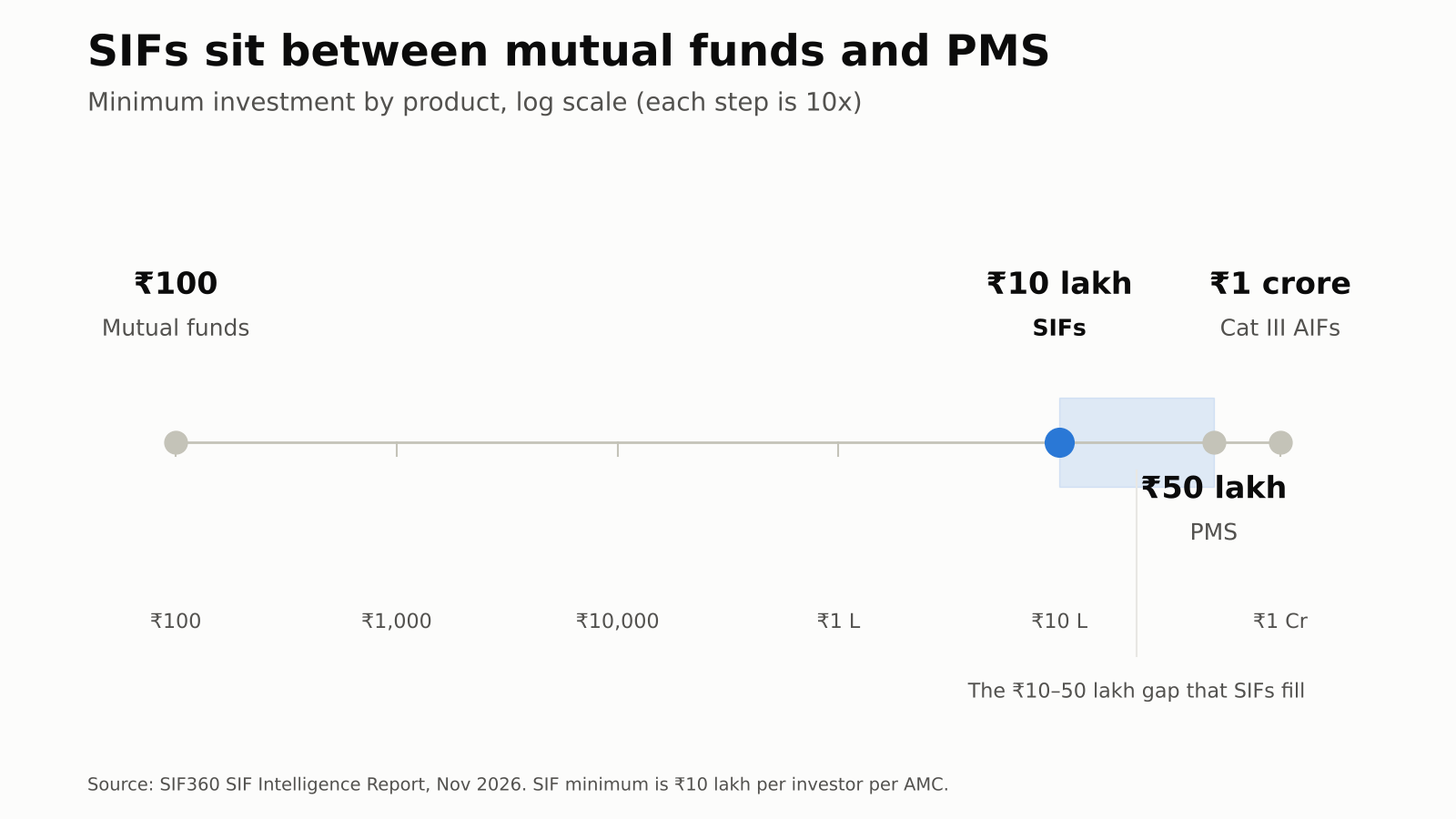
This matters because most of our users are traders. Many of them put large amounts of money into the market, and they already understand shorting, hedging and arbitrage. SIFs are the first product under mutual fund rules that can use these same tools, and they start at ₹10 lakh instead of the ₹50 lakh a PMS needs.
The timing is right too. SIF assets grew from ₹6,564 Cr to ₹42,669 Cr in the first ten months of 2026. The SIF360 report expects ₹1.5 lakh crore of future SIF money to come from traders and direct investors. In this article, we explain why SIFs fit traders, what the data shows, and what will drive their next phase of growth.
Why SIFs: the gap they fill
An SIF is a fund category that SEBI introduced in 2025 under the mutual fund rules. It needs a minimum of ₹10 lakh per investor at the AMC level, which places it right between mutual funds and PMS.
The main difference from a regular mutual fund is that an SIF can take short positions. It can hold up to 25% of its NAV in unhedged shorts through derivatives. Total exposure is capped at 100% of NAV, so there is no leverage.
SEBI allows seven SIF strategies, and five of them have live funds today. These are Equity Long-Short, Equity Ex-Top 100 Long-Short, Sector Rotation, Hybrid Long-Short and Active Asset Allocator. Because SIFs follow mutual fund rules, they also get mutual fund style transparency and taxation.
The data is backing SIFs strongly
SIF assets have grown every single month of 2026. In October alone, AUM rose 11.6% and about 20,000 new investor accounts were added.
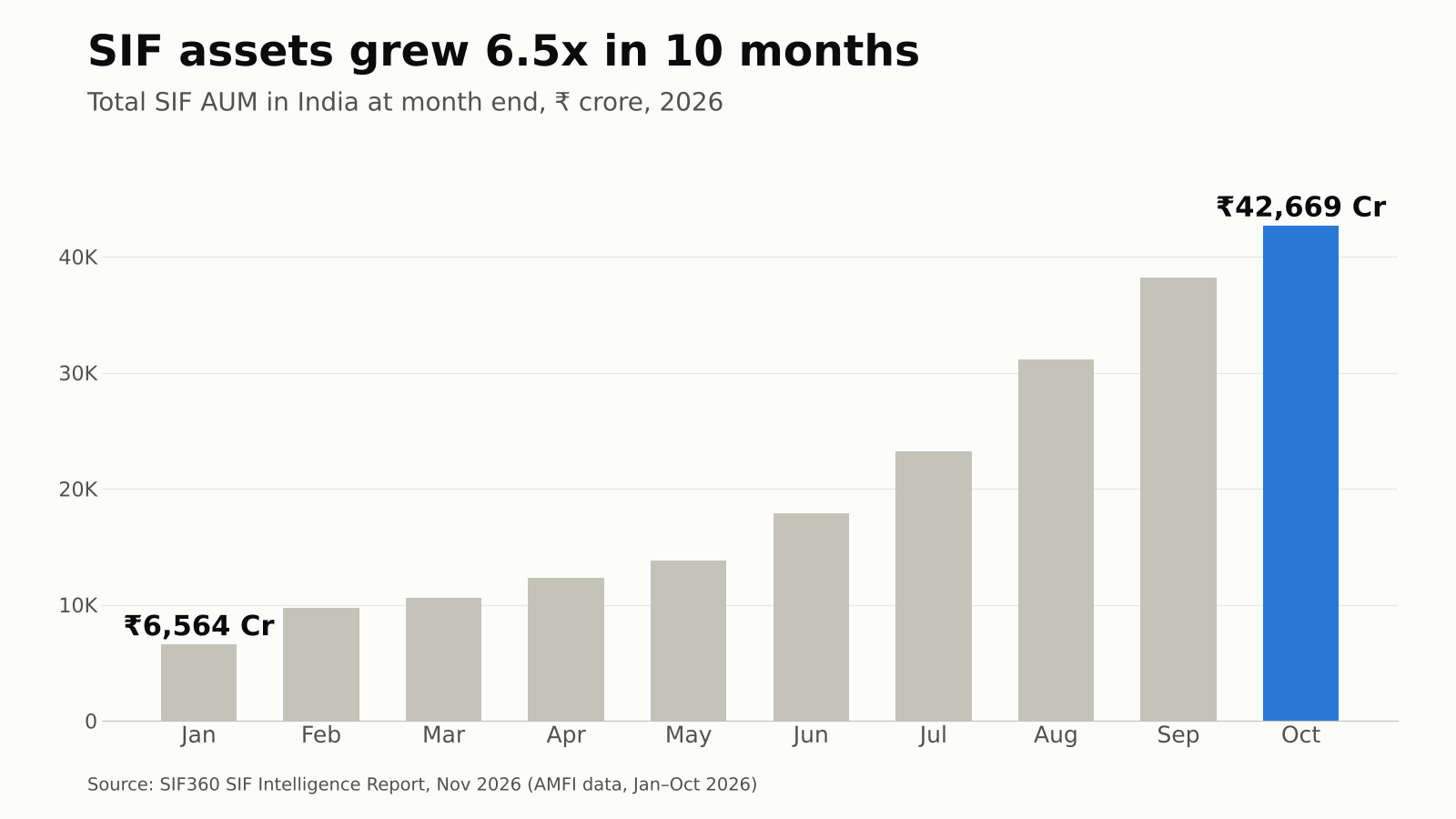
By 31 October 2026, there were 37 live SIF schemes from 18 AMCs, with 1,76,542 investor accounts in total. Ten platforms have already crossed ₹500 Cr each. Edelweiss’s Altiva leads with ₹14,370 Cr, followed by ICICI Prudential’s iSIF and SBI’s Magnum. The report also lists more AMCs that are preparing to launch, so the number of schemes should keep rising.
Most of the new money is going into hybrid strategies. These funds mix equity, debt and arbitrage, and they move much less than pure equity funds.
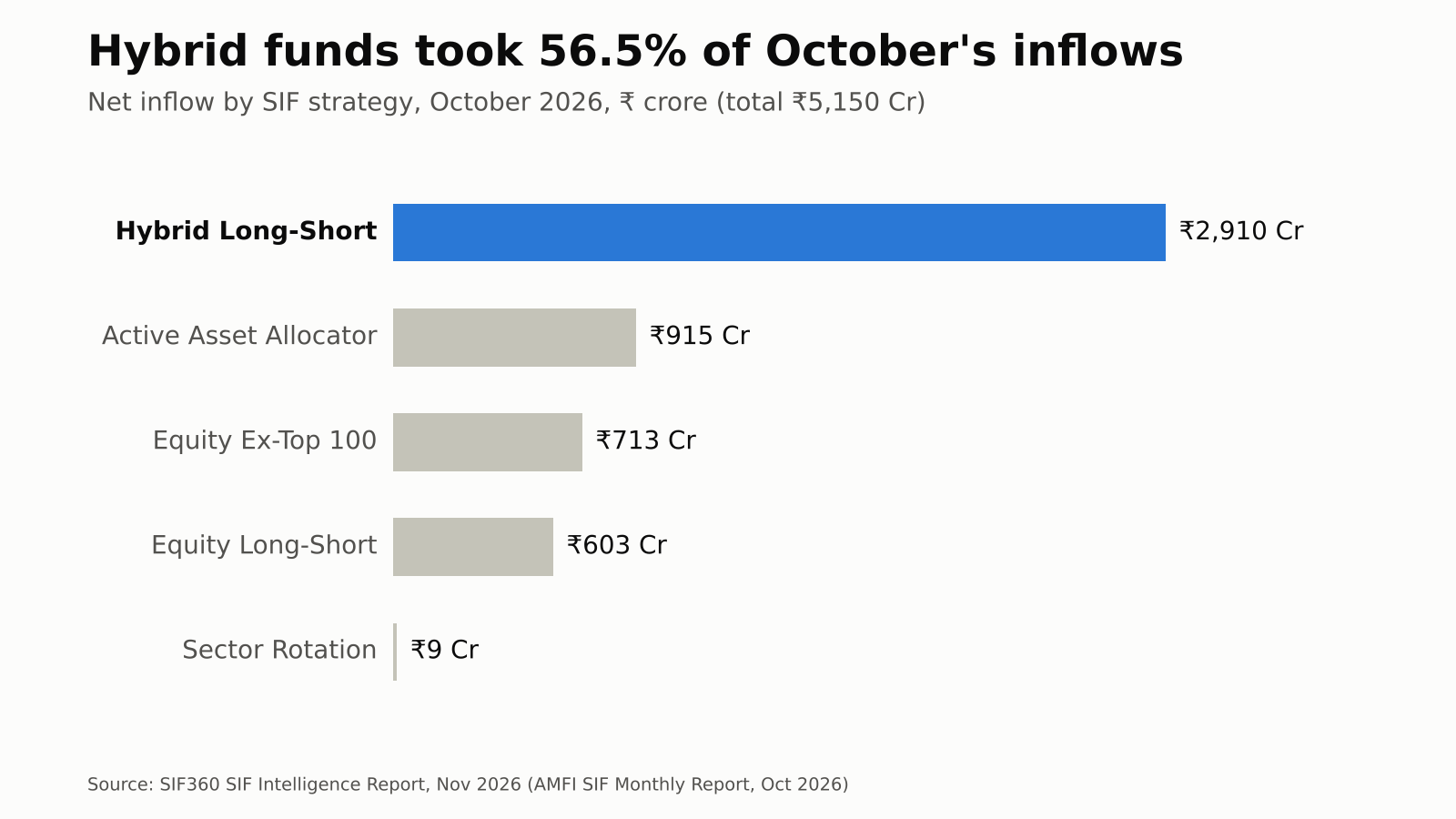
This tells us that most SIF investors today want a steadier product with some hedging built in, rather than an aggressive equity bet. Hybrid strategies now hold about 70% of all SIF assets.
What will drive the next phase of growth
The SIF360 report estimates that SIF assets could reach ₹5 lakh crore by 2028, up from about ₹0.43 lakh crore today. This is an estimate, not a certainty, but it shows how much room the category still has.

We see six levers that can take SIFs there:
- Large mutual fund investors moving up. About 25 lakh mutual fund investors hold more than ₹10 lakh, and about 5 lakh hold more than ₹50 lakh in a single AMC. The report expects ₹3.5 lakh crore to come from this group, including people who recently invested a lump sum of ₹10 lakh or more.
- Traders and direct investors. Another ₹1.5 lakh crore is expected from people who invest in direct equity, margin trading, F&O and real estate today. They want a professionally run strategy that still gives them liquidity.
- More AMCs and more schemes. There are 37 schemes from 18 AMCs today, and the report lists more AMCs that are launching soon. Three new SIFs opened for investment in October alone, raising ₹679 Cr through NFOs.
- Strategies that are still empty. The two debt strategies, Debt Long-Short and Sectoral Debt Long-Short, have no live fund yet. Sector Rotation has only one fund. Each new strategy gives investors a new reason to come in.
- A better post-tax option than FDs. The report notes that experienced investors keep about half their money in FDs and bonds. These earn 6–8% before tax, and after tax at 30–40%, often only 4–5% is left. Low-volatility hybrid and arbitrage SIFs give these investors a tax-efficient alternative to consider.
- Easier access. Investors can now buy SIFs on broker platforms like Dhan, using their existing account and KYC. Tools that explain each strategy in plain language make it easier for a new investor to start.
Market conditions will play a part too. SIFs are designed to hold up better in sideways and falling markets, so a choppy period could bring more investors to them.
Why traders are a natural fit for SIFs
Most Dhan users are traders, and many of them put a large share of their money into the market. They are used to taking risk, and they already understand ideas like shorting, hedging and arbitrage. For this group, an SIF is a familiar way of investing, not a strange new product.
There are three reasons SIFs suit traders well:
- They use the same tools traders use. Many hybrid SIFs run cash-futures arbitrage and covered calls. HSBC’s RedHex, for example, had 0% net equity at the end of October because every stock it held was matched with a short future.
- The tax works differently. When you run these trades in your own account, the profit is usually taxed as business income at your slab rate. Inside an SIF, there is no tax at the fund level. You pay tax when you redeem, based on how the fund is classified. Equity-oriented SIFs are taxed at 12.5% LTCG after 12 months.
- They are built for choppy markets. The report expects equity SIFs to do better than regular equity funds in corrections, sideways markets and bear markets. It expects them to lag in a strong bull run.
This is also why so many members of MadeForTrade asked for SIFs. The first request came in July 2025, and members kept asking until the launch.
What to check before you invest
SIFs give more freedom to the fund manager, so the gap between a good fund and a weak one can be large. In October, the best Equity Ex-Top 100 fund was flat while the worst fell 6.96%. On ₹10 lakh, that is a difference of about ₹69,565 in one month.
These are the points we would check for any SIF:
- Real short exposure. A fund may short up to 25%, but some barely do. quant’s Equity Long-Short fund was about 93% long in October, with an average short of only about 3%.
- Behaviour on bad days. On 8 October, the Nifty 500 TRI fell 2.01%. Only 12 of the 19 equity SIFs fell less than the index that day.
- Redemption days and exit loads. Some SIFs are interval funds that let you exit only on set days of the week. Exit loads range from nil to 3% within 30 days.
- Track record. Most SIFs launched in 2026, and many have less than six months of history.
- Your own fit. The report says SIFs are not meant for first-time investors, short-term money, or anyone expecting fixed returns.
SIFs are now live on Dhan
You can now invest in SIFs on the Dhan App. If you already invest with Dhan, you do not need a new account or a new KYC. You can read the full launch post here: https://madefortrade.in/t/introducing-sifs-specialised-investment-funds-investing-on-dhan/96131
- 30+ SIF schemes in one place, from different AMCs and across the SEBI-permitted strategies.
- Simple Insights explains each strategy’s approach, risks and portfolio allocation in plain language.
- Alpha View shows how your SIF investment is performing and how it compares with its benchmark.
- Split Orders lets you split one investment across eligible strategies from the same AMC in one go, subject to scheme rules.
More SIF releases are on the way. Once you try SIFs on the app, tell us below what worked for you and what we should improve. Which SIF strategy would you pick as a trader, and why?
Source: SIF360, SIF Intelligence Report, November 2026 (Vol 05). Data from AMFI and CAMS, as of 31 October 2026.
This article is for education only and is not investment advice or a recommendation to buy or sell any SIF. Past performance may not be repeated. SIF investments are subject to market risks. Please read all scheme-related documents carefully before investing.