If you’ve been tracking options this week, you may have noticed something unusual.
 Even at 3:25 PM on expiry day, the NIFTY ATM Straddle was still trading around ₹100.
A few weeks ago, this would’ve surprised many option traders.
So, what’s changed?
The answer lies in NSE’s new Closing Auction Session (CAS) and how the market now discovers the final closing price.
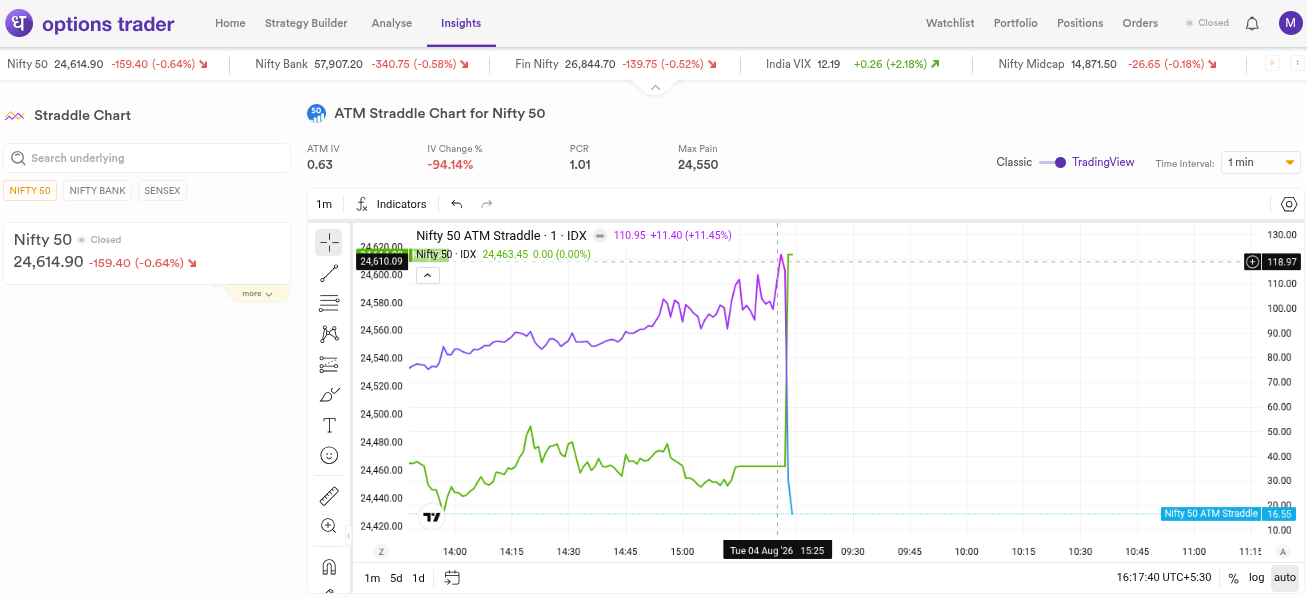
Before CAS: Premiums Usually Collapsed Before The Close
Under the earlier market structure:
• Cash market trading ended at 3:30 PM
• By 3:25 PM, very little uncertainty remained
• Traders already had a fairly good idea of where the index would close
Since options price uncertainty, there wasn’t much uncertainty left.
As a result, ATM straddles would rapidly lose their remaining time value during the last few minutes of trading.
Watching premiums collapse into expiry had become almost routine.
What Changed With The Closing Auction Session?
Now, the market follows a different closing mechanism.
After 3:15 PM, eligible cash market stocks enter the Closing Auction Session (CAS), while index derivatives continue trading until 3:40 PM.
This means the final closing price of many F&O stocks is determined through the auction process, rather than continuous trading.
This seemingly small structural change has introduced a new element into expiry-day option pricing.
Remember What An ATM Straddle Actually Prices
Many traders think an ATM straddle is predicting whether NIFTY will move up or down.
That’s only part of the story.
More importantly…
An ATM straddle prices uncertainty.
As long as uncertainty exists regarding the final settlement value, option premiums can retain value.
And after CAS, that uncertainty continues well beyond 3:15 PM.
Why Does The Auction Matter?
NIFTY is an index made up of multiple constituent stocks.
If many of those stocks are still awaiting their final auction-determined closing prices, traders cannot know the exact final index value until the auction concludes.
Even if the index appears stable on screen, the auction can still influence the settlement price.
That remaining uncertainty gets reflected in option premiums.
The Role Of Market Makers
Market makers continuously provide liquidity in the options market.
Before CAS, the final few minutes involved relatively limited uncertainty, allowing option premiums to decay more aggressively.
Now, market makers also have to account for auction-related settlement risk.
Rather than reducing premiums aggressively before the close, they may continue pricing in some uncertainty until the auction process is completed.
This can result in ATM straddles retaining higher premiums closer to expiry.
Is ₹100 The New Normal?
Not necessarily.
These are still the early days of the new Closing Auction Session.
Institutional participants…
Market makers…
Algorithmic traders…
Liquidity providers…
are all adapting to the revised market structure.
It may take several expiry cycles before new pricing behaviour becomes consistent.
What Traders Should Observe Over The Coming Weeks
The introduction of CAS could gradually change how traders interpret expiry-day option pricing.
Some interesting things to monitor include:
• ATM Straddle premiums after 3:15 PM
• Changes in Implied Volatility (IV)
• Auction participation and volumes
• Premium decay patterns
• Settlement day behaviour across weekly expiries
It will be interesting to see whether the market develops a new “normal” for option pricing near the close.
Let’s Discuss
Have you noticed this change in expiry-day option premiums?
Do you think the Closing Auction Session will permanently change:
• ATM Straddle behaviour?
• Premium decay near expiry?
• IV dynamics after 3:15 PM?
Or do you expect the market to eventually adjust back to earlier pricing patterns?